Different materials need a considered connection
Render beside timber trim: plan the junction
Timber trim and render can sit comfortably together, but they do not become one material because they share a colour. A junction must account for the timber's condition, its purpose and the surrounding wall build-up. It also needs to remain practical to maintain. This article considers the decisions behind that connection on an Alderley Edge exterior: what is staying, what needs repair, how the materials will meet and which details must be settled before the visible finish is applied.

On this page
Establish what the timber does
Some timber is decorative; some forms part of a frame, a window assembly or another important building detail. Its appearance alone may not establish its role. Before removing, trimming or covering it, understand what it is connected to and whether the proposed work could affect the building fabric. Appropriate professional assessment may be needed where its condition or function is uncertain.
A rendering contractor should not be expected to make that decision through a finish-only quotation. If timber repair belongs to another trade, identify the responsible party and the information they must supply. That may include the final dimensions, surface treatment and junction arrangement. The wall work can then be priced around a known detail rather than a provisional assumption that the timber will be ready.
Examine the edge that is normally hidden
The exposed face may look sound while the interface behind an old covering tells a different story. Where investigation is justified, plan it carefully and protect the area afterwards. Look for the condition of adjoining material, earlier repairs and the route by which water reaches the junction. The aim is to establish the actual problem rather than conclude that any dark mark proves decay.
If render is being removed nearby, agree how the retained timber will be protected from tools and falling material. A hard covering tight against an edge can complicate removal. The work should stop for review if an unexpected condition appears. Continuing because the area will eventually be painted can turn a limited investigation into unnecessary damage to something that was intended to remain.
Decide whether the existing alignment should stay
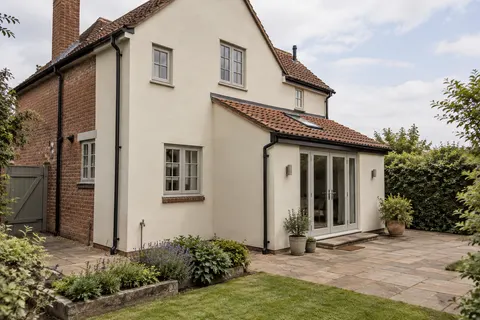
A new render build-up can alter the relationship between the timber face and the surrounding wall. Timber that once projected may become nearly flush or recessed. Consider that change before choosing the final thickness or deciding to retain old layers. The resulting edge affects the appearance and may affect how the detail is weathered and maintained.
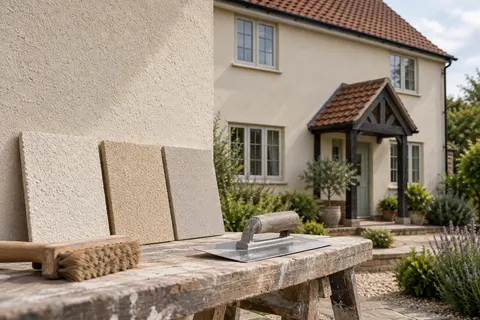
The wall-rendering guide explains why an elevation needs its edges defined as carefully as its main face. Where the intended alignment cannot be achieved without changing the timber or wall, make that alteration explicit. A sample of colour alone will not reveal whether the finished junction becomes awkward after several layers are added around it.
Use a junction detail appropriate to the materials
The connection should be specified for the actual system and construction. A rigid bridge across a joint is not automatically suitable simply because it can be finished neatly. Equally, a visible gap without a designed purpose is not a complete answer. The detail needs to explain the separation, weathering and any specified joint materials rather than relying on improvised filling during finishing.
Keep the relevant product guidance and drawing together. If a sealant or trim is proposed, identify its role and compatibility with the adjoining surfaces. It should not be treated as a universal remedy for an unresolved design. The exact arrangement may differ between a modern decorative trim and timber associated with older construction, even when the exterior photographs look superficially similar.


Older walls may need a different surrounding finish
Traditional masonry or timber-framed fabric can require a compatible wall approach. The lime-render guide discusses why selection follows the construction and condition, not simply the age suggested by the frontage. Later cement patches or coatings may complicate the assessment. Their removal or retention should be considered with the risk to the adjoining timber and original fabric in mind.
Historic England and SPAB guidance provide useful principles for repair, but they do not diagnose an individual junction from a photograph. Where the property has heritage protection, the proposed treatment may also need the relevant consent or agreement. Check the actual designation and scope with the appropriate authority instead of assuming that a nearby conservation-area name determines the answer.
Coordinate timber decoration with render finishing
Timber may need its own preparation and decorative treatment. Decide when that work happens in relation to removal, base preparation and the render finish. The chosen sequence should avoid damaging a newly coated surface or trapping a necessary repair behind completed wall work. Allow the relevant materials to reach the condition required for the next operation.
A shared colour does not remove these separate requirements. Products suitable for timber may differ from those used on render, and the appearance can vary with sheen and texture. View the intended combination together rather than selecting each from a different chart in isolation. If the timber is to remain unpainted, its protection and subsequent maintenance still deserve an explicit place in the brief.
Plan for future maintenance without destructive work
A good-looking junction should also be accessible enough for the relevant maintenance. Consider whether timber surfaces, fixing points and joint materials can be inspected and treated after the render is complete. Burying an edge may make the initial finish look simple while creating a difficult repair later. Discuss which parts are expected to remain accessible and how the final detail supports that.
Keep information about the materials and the junction with the property records. If a future decorator or installer encounters the edge without that information, they may apply an unsuitable coating or fill a deliberate separation. A short drawing and product record can prevent the junction being gradually altered through well-intentioned maintenance that no longer matches its original purpose.
Describe the work without a catch-all allowance
A quotation should distinguish timber investigation or repair, background preparation, rendering, decoration and final joint work. If some tasks are excluded, identify who will undertake them and when. A phrase such as finish neatly around timber does not establish the condition expected before the rendering begins or the treatment of an unexpected defect.
Use the Alderley Edge exterior guide to place the detail within the wider project. A single wall and a whole-house refurbishment may encounter the same junction, but their access and sequencing can differ. The practical arrangement should follow the actual site. A small retained feature can influence the programme if another trade must repair it before several wall stages can proceed.
| Work item | Agree |
|---|---|
| Timber condition | Who assesses and repairs it |
| Wall build-up | Its final depth and preparation |
| Junction | Designed connection and compatible materials |
| Decoration | Separate timber and render treatments |
| Handover | Access for maintenance and retained records |
Review the completed connection as well as the surface
Inspect the timber, render and junction together after the relevant curing and drying stages. Look for conformity with the agreed detail, accidental coating of excluded surfaces and any unfinished reinstatement. Assess appearance from normal viewing positions, then inspect the edge closely for the specific matters the design was intended to resolve. These are related but different parts of the review.
Record any outstanding work with its location and responsible trade. Keep the approved detail, photographs and maintenance information together at handover. That makes it easier to understand a later change without guessing whether it was present from the start. A considered junction should remain understandable after the people who carried out the refurbishment have left the project.
Common questions
Can render simply cover the edge of a timber board?
That should not be assumed suitable. Establish the timber role, condition and maintenance needs, then use a junction detail appropriate to the actual wall system. A neat initial appearance does not demonstrate that a concealed connection will perform properly.
Does matching the paint colour make the junction disappear?
Not necessarily. Timber and render can differ in texture, sheen, alignment and weathering. A sample should show the combination, while the technical detail must remain suitable whether the visual contrast is strong or subtle.
See housing and planning information for Alderley Edge and nearby places, including the source and geography behind each figure.