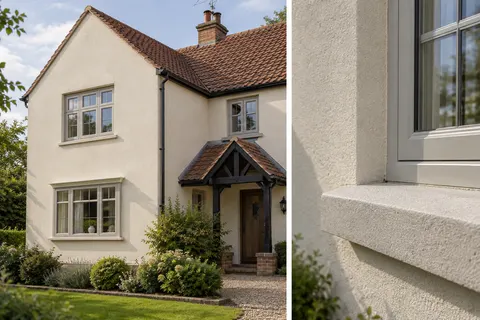
Change the colour without hiding the condition
Render colour change in Alderley Edge | Surface preparation
A colour change can be a smaller intervention than replacing the render, provided the existing wall is sound and the proposed coating is compatible. The word respray describes a method of application, not a diagnosis or a complete specification. For an Alderley Edge exterior, the important decisions are what needs repairing, what should remain uncoated and which system is suitable for the surface already there. A change of colour should not be used to disguise an unresolved wall defect.

On this page
Decide whether this is decoration or repair
Start with the condition of the existing finish. Loose areas, open cracks and persistent staining need assessment before a decorative coating is selected. A wall may require local repairs followed by a wider colour treatment, but those stages should be identifiable in the quotation. Painting everything the same shade does not make the underlying materials equally sound.
If the render is firmly attached and the concern is primarily its appearance, a coating route may be worth investigating. If it has failed extensively, replacement may be more appropriate. The repair guide and wall-rendering guide help distinguish those scopes. The intention is to choose the least extensive suitable work, not to make every surface problem into a full re-rendering project.
- Clean Washed down, with algae and mould treated and left to work.
- Repair first Cracks and hollow patches are repaired before any coating.
- Prime or stabilise Where the coating maker requires it on that surface.
- Coating Usually two coats of a breathable masonry or silicone coating.
The usual order of work. The survey and the chosen products decide the actual steps.
Identify existing coatings as well as the render
A wall can carry several layers of paint or a proprietary decorative finish. Their condition and compatibility affect the preparation and the choice of new coating. An application method cannot compensate for an unsuitable layer underneath. Ask how the surface will be identified and what evidence supports retaining it as part of the new build-up.
A trial can help reveal adhesion or appearance issues, but it should be designed for the question being asked. A tiny colour sample does not establish the suitability of coating a whole elevation. Where product information is available from earlier work, provide it during the assessment. If it is missing, the proposal should acknowledge that uncertainty and describe the necessary investigation.
Separate cleaning from changing the colour
Surface marks do not always justify a new coating. Appropriate cleaning may improve the appearance of a sound finish, while marks caused by water repeatedly running down a wall may return unless that route is corrected. Identify the type and position of the staining before selecting a cleaning method. The installed product guidance should govern treatment where it can be established.
Do not assume a more forceful method produces a better result. Fragile surfaces and adjoining materials can be damaged by unsuitable cleaning. Agree a trial and the acceptable outcome before treating a large area. Cleaning may reveal differences that were previously obscured, so review the wall afterwards rather than treating the initial appearance as the final basis for a colour decision.
Write down what will remain unpainted
Stone sills, exposed brick, timber trim, vents and metal fittings can easily become ambiguous at the edge of a coating job. Create an exclusion schedule and mark the boundaries on photographs. The decision should cover small returns and concealed edges as well as obvious features. A consistent wall colour does not require every adjacent material to receive the same treatment.
The article on colour boundaries and retained materials develops this approach. It also helps when comparing quotations: one contractor may assume that trim is included, while another prices only the render. Those proposals have different scopes even if they quote the same colour and describe the same elevation.
| Feature | Agree before work |
|---|---|
| Exposed brick or stone | Remain uncoated and protected |
| Timber trim | Separate preparation and coating decision |
| Pipes and fittings | Removal, masking and reinstatement |
| Repaired patches | Drying, compatibility and final appearance |
Compare application methods through the site constraints
Spray application may be proposed for some surfaces, but masking, overspray control and surrounding conditions need consideration. Brush or roller work may be appropriate in other circumstances or for particular details. The chosen method should suit the product and location, not merely be selected because the service is described as a respray.
Discuss nearby glazing, cars, planting and neighbouring property. Access routes and occupied areas may affect how the work is contained and sequenced. Protection must be suitable for the retained materials and removed without damaging them. The quotation should identify these arrangements rather than leave the owner to infer that everything around the wall will somehow be covered.
Assess the sample after suitable drying
Colour on a textured wall can look different from colour on a printed chart. View a representative sample beside the frames, roof and masonry that will remain. Allow the coating to reach the condition specified for assessment before deciding whether it is acceptable. Compare it at the normal viewing distance as well as close to the surface.
Where local repairs are involved, the sample should take account of the repaired and retained backgrounds. Different surface profiles may remain visible beneath a uniform colour. A coating can alter tone without making every patch disappear. Agree whether that variation is acceptable or whether additional preparation and a larger finishing scope are needed.
Coordinate fittings and future maintenance
Downpipes and other fittings can obscure narrow strips of wall. Decide whether they will be temporarily removed, worked around or replaced, and identify the trade responsible. Coating around a fitting that is about to be changed can leave an obvious uncoated outline. Conversely, removal may expose a fixing or junction that needs attention before it is covered again.
Keep the new product and colour information with the property records. Future cleaning and repairs should follow guidance for the actual coating, which may differ from the instructions for the original render beneath. If the wall incorporates external insulation, later fixings also need to respect that build-up. A colour change does not turn an insulated facade into ordinary bare masonry.
Check the boundaries at completion
Review the coated areas against the marked scope, including returns and reinstated fittings. Examine the materials that were supposed to remain untouched and note any masking or cleaning issues. Use the approved sample and agreed viewing conditions to discuss the finish. A snagging item should identify a location and concern rather than leave the contractor to guess what is being disputed.
The whole-house rendering page may be useful where the colour change is part of a wider exterior project, while the cost guide separates decorative work from repairs and access. Retain the final scope as well as the product reference. It will explain why some areas received a coating and others were deliberately left as they were.
Common questions
Will recolouring hide every repair?
Not necessarily. A coating can make the colour more consistent while differences in grain, profile or repair edges remain visible. The trial and specification should address that appearance rather than imply that a uniform shade creates a perfectly uniform surface.
See housing and planning information for Alderley Edge and nearby places, including the source and geography behind each figure.