A sample should answer more than a colour question
How to judge a render sample from near and far
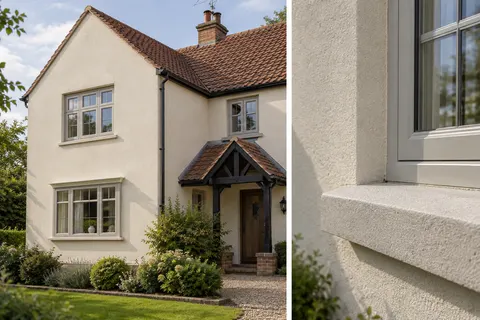
A render sample can look convincing at arm's length and surprisingly different across a whole facade. The opposite can happen too: a grain that seems prominent close up may become a quiet surface from the pavement. A useful sample review considers both views without pretending that either is the only correct one. For an Alderley Edge project, the aim is to choose the intended finish in the setting where it will be seen and to keep a clear reference for the completed work.

On this page
Decide what the sample is meant to prove
A colour chip, a loose textured board and a trial on the wall answer different questions. The chip helps narrow a colour range. A board shows more of the texture. An agreed site trial can help demonstrate the appearance on a representative background and around a relevant detail. State the purpose before treating one type of sample as evidence for every part of the proposed finish.
A decorative sample is not a test of the whole building's condition. It cannot establish that all existing render is secure or that an insulated build-up has been designed correctly. Those matters require their own assessment. Keeping the distinction clear prevents a successful-looking patch from being used to approve preparation and details that the sample never attempted to represent.
Choose a representative place to view it
If the wall will be seen mainly from a path or driveway, include that position in the review. Also consider the principal rooms and garden where the exterior is regularly visible. A sample hidden in a shaded corner may be convenient to apply but unrepresentative of the main elevation. Discuss whether a movable board or more than one viewing position would better support the decision.
The surroundings matter as much as distance. Place the sample beside the actual brick, frames, roofing or stone wherever practical. A neutral background can make comparisons easier at first, but it does not reproduce the finished facade. An apparently warm white may look different beside a cool window frame or a strongly coloured brick. The final choice should acknowledge that combination.
Take the pavement view first
Stand where the building is normally approached and look at the sample as part of the elevation. Consider whether its colour and texture support the intended appearance without requiring close inspection to make sense. Look at the relationship between the sample and larger features, including window spacing, roof shape and retained masonry. This is an aesthetic review of the composition, not a judgement about hidden workmanship.
A small sample can be difficult to assess at this distance. If so, acknowledge the limitation rather than pretending the exercise has settled the whole-facade effect. The contractor or specifier may propose a more representative trial. The useful question is whether the sample gives enough information for the particular decision, not whether it meets an arbitrary size chosen without reference to the building.
| View | Useful question |
|---|---|
| Normal approach | Does the finish sit well with the whole facade? |
| Close inspection | Is this the expected grain and detail? |
| Different daylight | How does relief and colour perception change? |
| After suitable drying | Is the sample ready to become the reference? |
Move closer to compare the grain
At close range, examine how the texture appears and whether it is the finish expected from the specification. Silicone thin-coat finishes and scraped monocouche finishes can have different visual character. Their product names alone do not show the grain or relief that will be visible beside a doorway or at a low garden wall. Compare like with like when reviewing alternatives.
Do not turn the close view into an unsupported universal workmanship tolerance. The contract, product guidance and agreed sample need to establish the standard for the actual work. A photograph taken from a few centimetres away can exaggerate small variations, while a distant view can conceal a detail that needs correction. Both views have a role when they are used for the right question.


Return when the light changes
Low-angle sunlight can emphasise surface relief and shadows that seem less apparent in flat light. A north-facing or sheltered location can also look different from an exposed bright elevation. Observe the sample under more than one ordinary lighting condition where practical. This helps avoid choosing a finish solely from one favourable moment in the day.
Keep the observations descriptive. Note that the grain appears stronger in side light or that the colour looks warmer beside a particular material. There is no need to invent numerical ratings for brightness or local preferences. The point is to understand the range of appearances the chosen finish can have, then decide whether that range suits the building and the owner's expectations.
Allow the material to reach the right condition
A newly applied sample may not yet show the appearance intended for review. Follow the relevant product guidance about drying and curing before making the final judgement. Damp material and temporary protection can affect what is visible. Ask the person responsible for the sample when it can reasonably be assessed and whether any later change should be expected.
If a sample is altered, keep track of what changed. A second coat, different preparation or revised texture can make it a different reference from the original proposal. The final approval should identify the sample that will govern the work, not simply the location where several trials have accumulated. Remove ambiguity before the main material is ordered.
Include the edge that will matter most
A large flat patch may say little about a tight reveal, a projecting band or a junction with exposed stone. Where one of those features is important, agree whether the sample should include a representative detail. This can reveal a practical or visual issue that a colour-only trial misses. It also gives the team a clearer reference for repeating the detail across the elevation.
The Alderley Edge rendering guide explains how those individual choices sit within the wider work. If a project is limited to a single face, the relevant corners and stopping lines still need attention. A sample should not suggest that the entire facade will become one uninterrupted plane when the agreed scope contains retained materials, movement details or separate phases.
Record approval in plain terms
Identify the product, colour reference, texture and sample location. Add photographs that show both the setting and the closer surface, recognising that images do not reproduce colour perfectly. State what the approval covers and any matters still to be resolved. A short written note is more useful than a general message saying that the sample looks fine.
Where several people approve the finish, settle who has the final decision and how comments are consolidated. A managing agent, owner and designer may each be looking at different aspects. Their instructions should not conflict once application begins. The approved reference should be available to the contractor and anyone later reviewing the completed work.
Use the reference fairly at completion
Compare the finished work with the approved sample under appropriate conditions and after the relevant drying period. Check the agreed details as well as the broad appearance. If the final surface seems different, describe the location and nature of the difference so it can be assessed against the specification. Avoid changing the standard retrospectively because a new photograph or lighting angle looks unfamiliar.
Retain the sample information for future maintenance and repairs. A later patch may still differ from a weathered wall, but the original record provides a useful starting point. It helps separate a known product choice from guesswork and gives the next contractor a clearer understanding of what the exterior was intended to look like.
Common questions
Can a phone photograph settle the colour choice?
It can help keep a record, but screens, cameras and lighting can change the appearance. The physical sample beside the actual materials is the stronger reference. Keep the product and colour code with the photograph so the decision is not dependent on an image alone.
Does approving a sample accept every wall underneath it?
No. Define the approval scope. A finish sample can establish appearance without replacing substrate inspection, system design or the checks needed before the main work proceeds.
See housing and planning information for Alderley Edge and nearby places, including the source and geography behind each figure.